
Calendars and Guides for Gardening in Austin
Monthly Gardening Calendar for the Austin Area – Use this monthly gardening calendar for Austin and Central Texas to find out what you can plant right now and which gardening chores to add to your list.
Travis County Vegetable Planting Guide – For best planting and cultivation times for seeds and transplants – updated January 2025.
High Performing Vegetable Varieties for Central Texas – A helpful guide for choosing varieties that will perform well in your Travis County Garden.
Travis County Extension Education – For additional information on vegetable, fruit, nut, and herb gardening in Austin. Topics include what grows in Austin, problem solvers including information on Texas garden insects, plant disease, garden planning, harvesting, and other helpful gardening resources.
Native Plants – Use this website to find information on Texas native plants by Ecoregion, bee-friendly plants, central Texas milkweeds, hummingbird plants, and plants for drought provided by the Lady Bird Johnson Wildflower Center.
Tomatoes
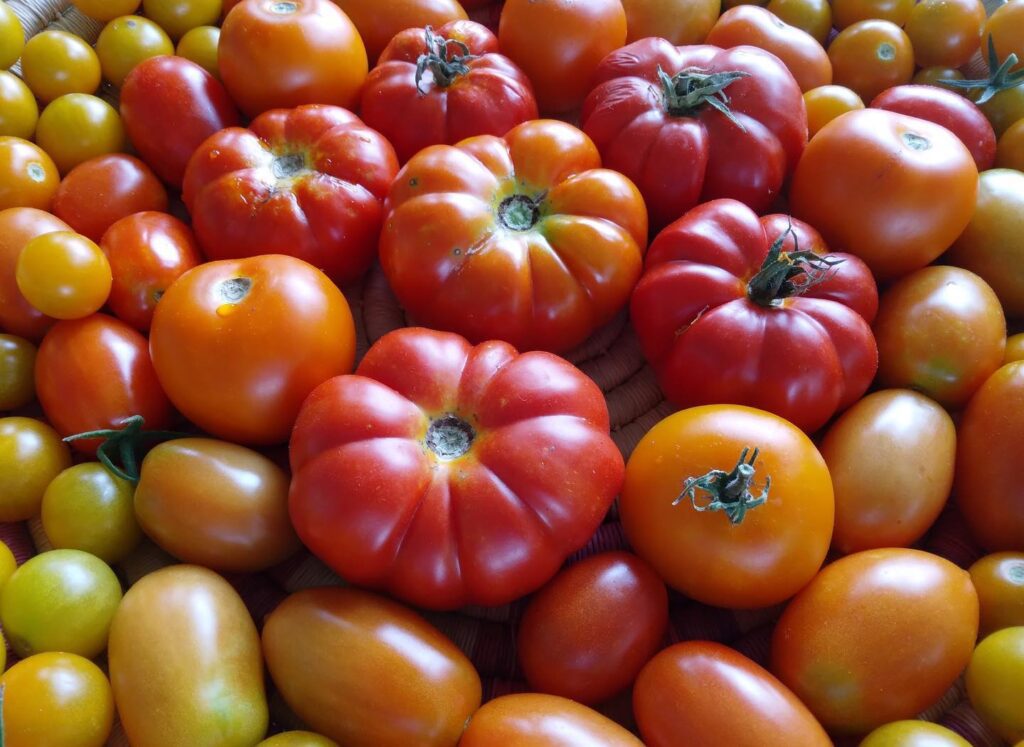
Each year, Sunshine Gardens grows a Tomato Trial Garden and holds a tomato tasting event to help determine the best varieties for our gardeners.
Tomato Trials:
In the Tomato Trial Garden, four plants of eight varieties are grown each Spring and since 2011, a total of 95 varieties have been grown.
In 2024, tomatoes were harvested May 1st – June 14th. Over 840 tomatoes were harvested from 32 plants. Below are the varieties and average number of tomatoes harvested per plant for each of the varieties.
- Better Boy – 11
- Better Boy Plus – 17
- Celebrity – 24
- Celebrity Plus – 33
- Heatmaster – 43
- Lemon Boy – 26
- Lemon Boy Plus – 35
- Jolene – 25
The overall average number of tomatoes harvested per plant in 2024 was 26, compared to recent years, 2021, 2022, and 2023, which were 30, 14, and 38, respectively.
Tomato Tasting:
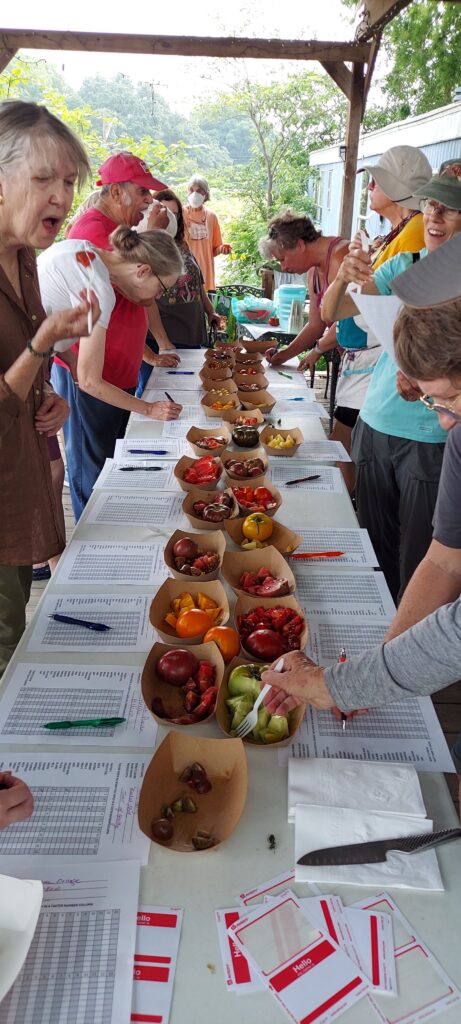
The Tomato Tasting took place on Saturday, May 25 and was well attended. The consensus was that this year’s tomato plants were mostly productive and the harvest looked good, but due to plentiful rain in April and May the tomatoes turned out overly juicy or watery, and tended to be bland. So, take this year’s ratings and recommendations with a grain of salt.
The comments next to the varietal names are only included if several people marked the same thing on score sheets. Since so many tomatoes were judged as Juicy or Watery this year, those categories are not included.
Varieties Most Tasters Said They Want to Grow:
4th of July (Mild, Tangy, Classic)
Black Cherry (Sweet, Tangy, Complex)
Cherokee Purple (Mild, Sweet)
Dwarf Eagle Smiley Yellow (Sweet, Complex, Balanced)
Flamme (Sweet, Classic)
Helsing Junction Blue (Classic, Tangy)
Lemon Boy (Mild, Sweet, Balanced, Tangy)
Lemon Boy Plus (Sweet, Tangy)
Olga’s Round Yellow Chicken (Meaty, Sweet, Balanced, Tangy)
Sungold (Sweet)
Sunrise Bumble Bee Yellow (Mild, Tangy)
Super Sweet 100 Hybrid (Sweet, Mild, Complex)
Zebra Ezel (Meaty, Mild, Savory)
Varieties Most Tasters Said They Do NOT Want to Grow:
Black Beauty (Mild, Sweet)
Brad’s Atomic Grape (Bland, Sweet)
Cerise Orange
Chef’s Choice Black (Bland, Mild)
Cherokee Green (Bland)
Early Doll
Early Girl
Indigo Red
Noah’s Stropes Dwarf
Park Star (Mild)
Polish (Bland, Mild)
Purple Boy Hybrid (Mild)
Super Sioux (Bland)
Varieties That Were Tied Between “Want to Grow” and “Do Not Want to Grow”:
Blush (Tangy)
Sandy’s Blueberries (Mild)
Black (Mild, Bland)
Organic Gardening
Sunshine Community Garden is an all-organic gardening community. Organic gardening is more than simply gardening without synthetic fertilizers or broad-spectrum synthetic pesticides. It is a comprehensive, holistic approach to gardening in a way that maintains and supports biodiversity and a healthy, balanced ecosystem.
Helpful Organic Gardening Resources:
Sunshine Community Garden Handbook, Appendix I – Organic Gardening Basics
Austin Organic Gardeners – The oldest organic gardening club in the U.S, since 1945, Austin Organic Gardeners have shared information about successfully raising vegetables and ornamentals without using harsh fertilizers and toxic pesticides that that harm the soil and disturb the ecological balance.
7-Step Guide to Organic Gardening – Basic organic gardening information from The Natural Gardener, a local gardening resource and destination known for its pioneering work in organic gardening and sustainable living.
Sunshine Organic Guidelines:
Please remember the following:
- For fertilizers, soil amendments, pesticides, and herbicides, use only products approved for organic gardens. Check the labels or ask the merchant or your zone coordinator when in doubt.
- These materials are prohibited from being used or brought on-site
- chemically treated lumber,
- wood that has been treated for moisture resistance, usually known as “treated landscape timbers,” and
- railroad ties.
These items contain chemicals that are neurotoxins, leach into the soil, and can be absorbed by the root systems of your vegetables.
- Coastal Bermuda hay is not recommended for mulching. It may possibly have been sprayed with the weed killer Picloran (Grazon is a common brand). This chemical will contaminate the garden soil for several years, leaving the plot unusable. Alfalfa hay is not at risk for this chemical and is a safe alternative.
Compost
Compost and compost tea have important benefits for organic gardening. They enhance soil structure and nutrient content, promote water retention, encourages beneficial microbial activity, and supports robust plant growth.
Compost for Sunshine Gardeners
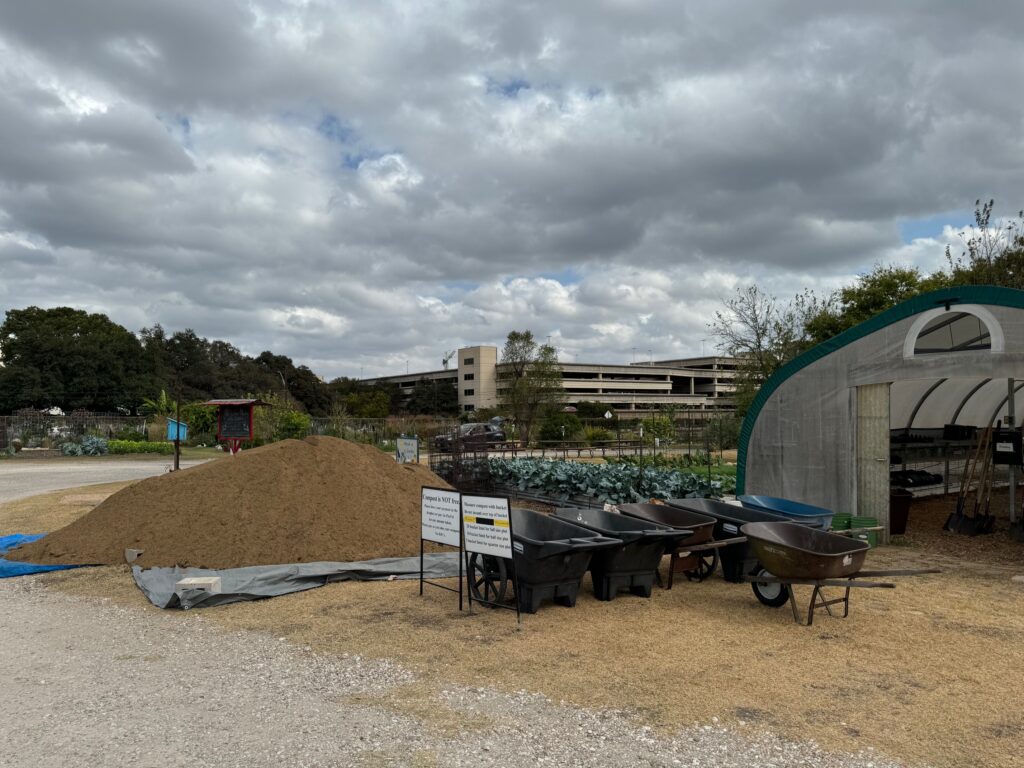
Sunshine Community Gardens provides compost to its gardeners in the Fall and Spring planting times, as well as when there is sufficient demand. Compost is available for purchase to the public at the Annual Plant Sale and Benefit.
When available, the compost price is per bucket and listed on the PayPal form. Method of payment is: Cash, Check or PayPal.
Please log your number of buckets on the clipboard in the hoop house no matter what payment form you use.
Allowable amounts of compost per garden are specified in the delivery announcements sent to all members. Though there are sometimes exceptions, the usual limits from the first delivery are as follows:
-
20 Buckets per full plot
-
10 Buckets per half plot
-
5 buckets per quarter plot
There is no profit to the garden on compost deliveries. The rates are based on the cost from the vendor to the garden delivery fees included. That total cost is divided by the expected number of buckets based on historic number of buckets sold and this determines the price.
Compost Tea
Sunshine Gardens has a compost tea generator located in the hoop house. Compost tea is generally available for gardeners during growing season on the weekends.
Gallon jugs are provided, and it is recommended to dilute at least 1:4. There is also a one gallon per weekend limit, unless there is still some left on Sunday afternoon. If that is the case, please use it up.
From the Grow Network:
Aerobic compost tea is also known as aerobic worm tea, and it is known mostly for its ability to boost microbiological activity in soil by adding beneficial bacteria, fungi, actinomycetes, and protozoa to the soil.
It is brewed either by soaking a porous bag full of worm castings in water or by simply dumping the castings into a container of clean, chemical-free water. Molasses, corn syrup, or another microbial food source is then added to the water as a catalyst to stimulate growth of the microbes. And finally, an air-pumping system is installed to create an aerobic (or oxygenated) environment for the multiplying microorganisms.
8 Benefits of Aerobic Compost Tea
- The microbes delivered in aerobic compost tea help plants by out-competing anaerobic and other pathogenic organisms within the soil.
- These beneficial microorganisms can also move in to occupy infected sites on plants’ root and leaf surfaces.
- Brewing aerobic compost tea speeds up the growth rate of microbes such as bacteria, fungi, protozoa, and nematodes, and multiplies their numbers exponentially. As a result, this method populates your garden with beneficial microbes more rapidly than applying worm castings alone.
- When you spray or pour the tea on the soil, you are not only feeding the plant, but also increasing the number of beneficial microbes in the soil, thus crowding out the bad ones.
- It has been proven that the tea, along with the castings, can significantly increase plant growth, as well as crop yields, in the short term (a season) and especially in the long term over a period of several seasons.
- Along with these great benefits come a boost in the plant’s own immune system, enabling it to resist parasites like the infamous aphid, tomato cyst eelworms, and root-knot nematodes. Plants produce certain hormones that insects find distasteful, so they are repelled. Aerobic compost tea also helps a plant to resist diseases such as Pythium and Rhizoctonia.
- When either worm tea or the more effective aerobic compost tea is sprayed on leaves and foliage, detrimental and disease-causing microbes are again outnumbered and cannot grow their numbers to dominate any single plant.
- The teas also help the plant in creating the “cuticle,” a waxy layer on top of the epidermis, or plant skin. This waxy surface protects the leaves from severe elements and reduces attacks by certain harmful microorganisms and insects.
Outside Plant Material Donations
The garden only accepts clean leaves and wood chips for mulching.
Please ensure that any trash, plastics, or pet waste is removed.
When delivering we ask that the material is placed as close to the existing pile as possible to prevent the pile from encroaching on neighboring gardens or being spread out.
We are not accepting any other materials from the public, and Sunshine gardeners should only provide plant material for composting. This is necessary to assist with rodent control efforts in the garden.
Watering Wisely
Our water bill consumes a major portion of our budget. We strive to conserve water while keeping in mind that a garden needs water. Growing vegetables is not a xeriscape activity.
Remember the following when watering:
- Mulch holds moisture in and reduces need for watering. Alfalfa hay, leaves, pine needles, and grass clippings work well.
-
Water early and in the morning so that the plants have time to absorb the water before the day gets too hot.
- The preferred method of watering is using soaker hoses followed by drip irrigation. Sprinklers are not allowed at SCG since sprinklers can cause water to evaporate before it reaches the roots of your plants.
- Deeper, less frequent watering, rather than shallow, frequent watering, produces better root systems that can support the plants in drought and heat conditions. Texas A&M recommends watering deeply once or twice per week.
- Water only when you are present; never leave running water hoses unattended, except for soaker hoses, which may be left on unattended during daylight hours for no more than three hours and at low pressure.
- Report plumbing leaks immediately and replace leaky hoses as needed. The plumbing contact can be found in the Members Only Contact List.
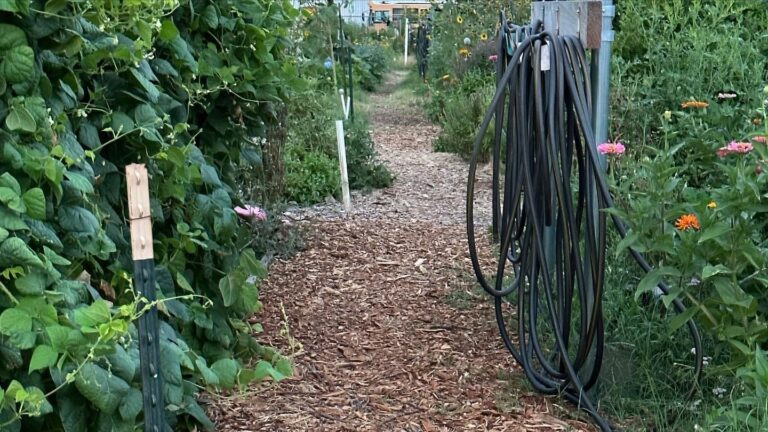
SCG maintains plumbing at the water stations, but the members must supply hoses. Be sure to keep hoses out of the paths to prevent tripping hazards. When hoses are not being used, they should be rolled in the plots or hung on the racks.
“Gardening requires a lot of water, most of it in the form of perspiration.”
—Lou Erickson
Invasive Plant Control
At Sunshine Community Gardens and many other central Texas gardens, a number of invasive non-native plants pose particular challenges. These plants crowd out our native plants, damage our gardens, and provide little to no benefit for our pollinators and wildlife. Some of the most challenging and agressive weeds we encounter at Sunshine include, Bermuda Grass, Bindweed, and Khaki Weed.
Bermuda Grass
The very traits that make Bermuda grass a good turfgrass make it extremely challenging in the garden. It grows rapidly through the production of long, wiry stems or stolons. In lawns, the stolons are mostly above ground or just under the soil. However, once the grass is disturbed, it changes its growth habit and sends below-ground rhizome stems deep underground. These can be difficult to remove, but failure to dig out every last bit of the plant will only result in future growth.
Bermuda grass is one of our worst weeds at Sunshine. Like bindweed (below), it can sufficiently decrease our crop yields by outcompeting our crops. It is especially important to keep it away from any perennial plants. If present, it will grow around the roots of those plants and become impossible to remove without digging up both it and the perennials. Tilling is particularly problematic as it chops the stolons into smaller pieces, all of which have the capability to root and resume growth. It goes dormant in the winter and might be easier to dig up then. Solarizing with black plastic during the heat of the summer is another control that is often used. Covering it with cardboard or newspaper, followed by wood chips will not stop it but it will slow down its growth and make it easier to remove.
Bindweed
Bindweed (Convolvulus arvensis) is an aggressive, persistent, invasive plant native to Europe. It is a member of the morning glory family (Convolvulaceae). It has medium-green, heart-shaped leaves, and white to pink bell-shaped flowers. Bindweed forms a dense mat of vines on the ground. It is also a vine that wraps around anything, including your crops. This can smother them and cut off their circulation.
Bindweed spreads by seed and root fragments. Root fragments as small as 2 inches form new plants. It has an extensive underground root system that grows horizontally about 12-18 inches deep. It has tender roots that break easily, making it very hard to remove from the garden. You have to insert a garden fork as deep as possible, pry and loosen the dirt until the weed lifts up with it and work the fork as you gently ease the weed out of the ground. Often the tender root will break off despite your efforts and will send up a new shoot.
You must keep removing it as soon as possible. If you are as persistent as the plant, the plant will weaken, and you will succeed in clearing your plot of this pesky weed.
Khaki Weed
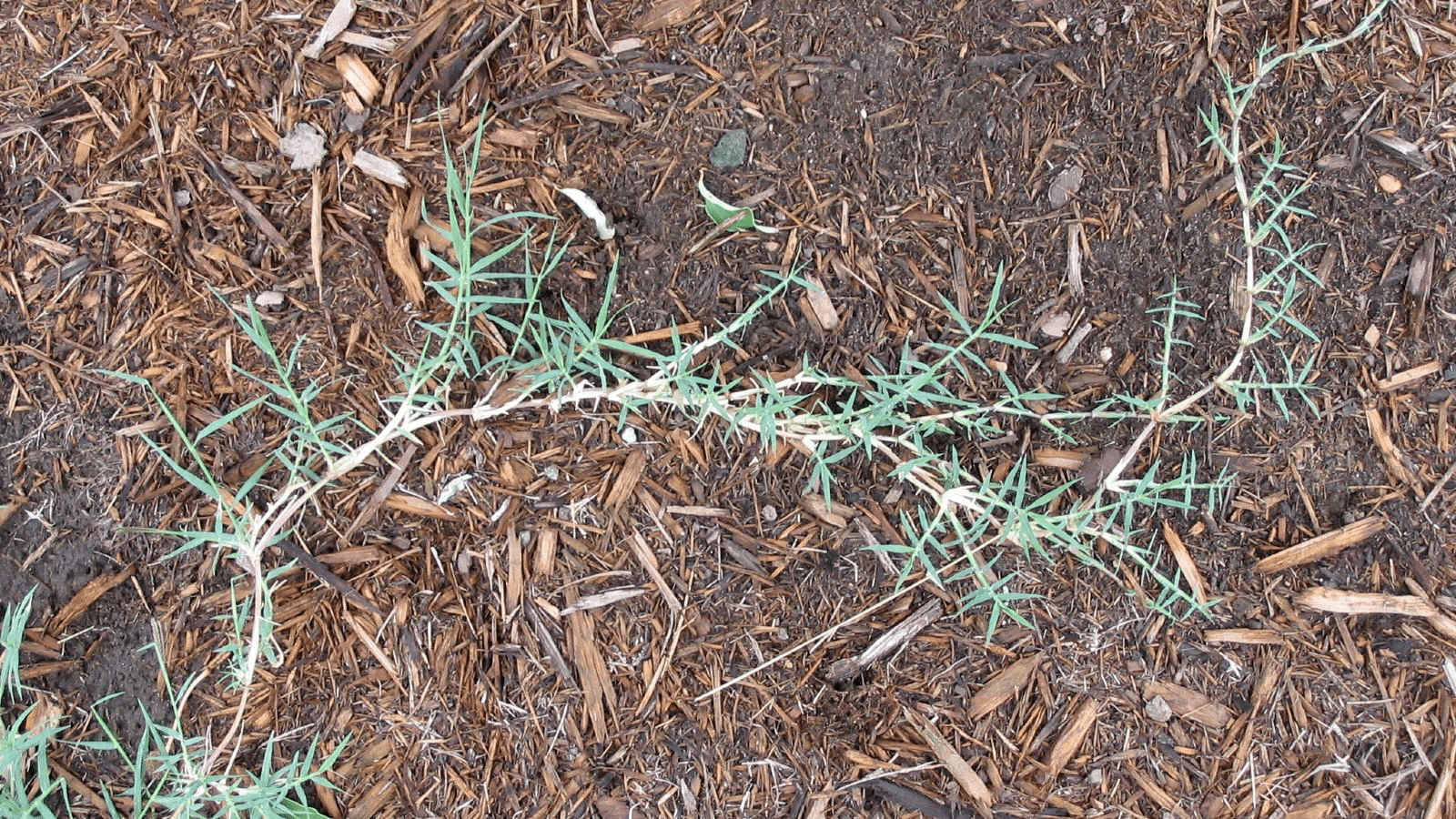
Alternanthera pungens and Alternanthera caracasana, commonly called Khaki Weed or mat chafflower is a highly invasive weed that is forming dense mats and taking over Sunshine Garden’s grassy areas. These weeds are easiest to identify when they have sticky burrs (seeds) that attach to whatever comes their way, spreading the plant.
These plants are impossible to eradicate but we should try to control them with this method of attack:
- Wear gloves
- Have a bucket or other container
- Have some sort of hand digging tool–a Hori knife works best
- Trace the plant back to its main stem. Try not to break off pieces as they can root.
- Lift the sticky plant carefully (as not to drop seeds) and put them in your container.
- Gather any remaining pieces of the weed that may have been broken off to prevent additional spread.
- Take the container and dump weeds in the Whittlesey plant pile. Whittlesey has assured us they can handle the weeds without additional concern for spread.
Time spent removing Khaki weed can be counted as both TSBVI and regular service hours.
Pest Management
Central Texas gardeners, including those here at SCG can sometimes encounter certain annoying critters. Our most common pests include ants, mosquitos, rats, rabbits, and Monk parakeets.
Ant Control
Ants are both beneficial and annoying to gardeners. They eat insects that might eat our crops but some species “ranch” aphids and distribute those pests on our crop plants. Most of our ant species are not a problem, and you should not attempt to control their populations. Please leave them be.
Red imported fire ants (Solenopsis Invicta, aka RIFA) are the exception to benign neglect. RIFA worker ants are variable in size. Their heads and thoraxes are dark brown, and their abdomens are black. They prefer disturbed areas, which describes any garden plot. They are commonly found at SCG. Their colonies often produce loose mounds of dirt above ground, especially in the wetter and milder months of spring and fall. The colonies at BFL may have adapted to the local environment in that they are often found under pavers or in pots. The first time you encounter them may be when you are digging in your plot. When disturbed, fire ant workers rapidly swarm in great numbers to defend their colony, possibly resulting in painful stings. You can minimize the impact of fire ants by wearing gloves and closed-toed shoes when gardening.
You may use only organic methods to try to control them in your plot. Our current method for treating them is a mixture of orange oil and liquid molasses. That mixture is generally available year-round and is kept in jugs under the tool cleaning station outside of the tool trailer/shed. Instructions are provided for diluting the concentrate for use in your garden. Once the drench is ready for use, be sure to use a container that pours a solid stream of liquid. Be sure to pour drench both in the center of the mound, as well as in a circular pattern covering the entire mound. Please notify your zone coordinator if you notice that we are running low on the mixture.
For additional information on organic fire ant control, visit Dirt Doctor – Organic Fire Ant Control.
Mosquitos
We follow the City of Austin recommendations for controlling mosquitoes. No standing water is allowed at any time of the year because it provides breeding areas for mosquitoes.
Several members have bird baths to attract thirsty birds away from juicy tomatoes or melons, which some birds peck to quench their thirst. If you have a birdbath, you must monitor it and change the water frequently.
Rats
Rat poison containers are placed around the garden to help control the rat population that our activities attract. Do not touch them or move them. We have a team that is responsible for monitoring rat poison.
Rabbits
Rabbits are sometimes a nuisance at SCG, devouring sprouting leaves and tender plants, and biting into melons and other juicy fruits.
If you see any rabbits in the garden or suspect that they have damaged your plants, please contact your zone coordinator to report the sighting. Picking your produce timely and making your plants harder to reach by creating barriers is effective against rabbits.
Inclement Weather
Central Texas can experience challenging weather conditions for gardeners, including extreme heat, frost and freezing temperatures, occasional high winds, heavy rains, and hail.
This section will provide helpful advice on how best to protect your garden during our most extreme weather conditions.
Frost and Freezes
When it Freezes at Sunshine Community Gardens
To protect the Sunshine Community Gardens water infrastructure, the water to the garden and the trailer will be shutoff. The shutoff usually occurs the day before the expected freeze and continues until temperatures rise above freezing.
Water shutoffs are announced via email and the website as soon as possible to allow gardeners time to prepare their plots and water if needed.
Please remember to protect the hose bibs by your garden during freezes by disconnecting the hoses that are attached.
Also, please double check those soaker hoses and make sure they are not left on accidentally.